Why Africa must own its own AI

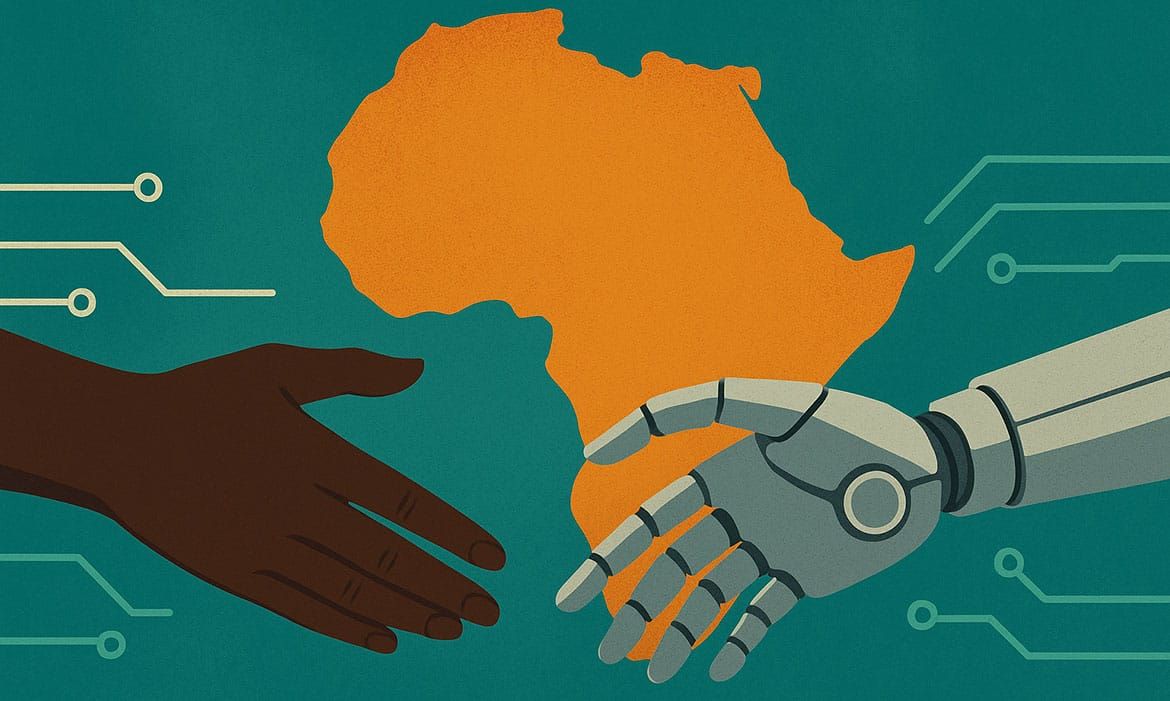
On 13th Nov, 2026, at approximately 9a.m., I received an alert from two of my banks that "Our email services are temporarily unavailable due to the Microsoft global outage." Outlook, Teams, and Copilot services were experiencing a disruption in 74 countries, services that around 430 million people rely on. By 2 p.m., Microsoft was still reporting only "marginal success," sending workers home early for the weekend.
Coincidentally, I was in the middle of writing one of the first articles on our blog: "Why Africa must own its own AI." The timing was rather poetic.
While most operations were eventually restored, imagine the system crash going on for days, disrupting markets, and bringing businesses to a standstill.
Currently the conversation on AI revolves around the US vs. China. US leads in raw computing power, frontier models, and capital investment, while China closes the gap in cost efficiency and actual real-world industrial development. The US has over 5,427 data centers compared to China's 449, and leading American labs (Anthropic, OpenAI, Google, and xAI) produce the most capable AI models with superior amounts of private investment compared to China's (DeepSeek and Moonshot AI's Kimi). China leads in industrial robotic installations, autonomous vehicles, and physical AI integration. In terms of R&D, China publishes the highest volume of scholarly articles and patents and controls minerals critical for tech supply chains.
Interestingly, Africa holds the vast reserves of the cobalt, manganese, graphite, and rare earth elements required to manufacture AI chips and server hardware, which is the cornerstone of building data centers. While the US & China are battling aging populations, Africa's working population is expanding rapidly, and global tech firms such as Sama have utilized Africa's low-wage data annotation. Nevertheless, Africa is not steering the AI conversation.
Historically, Africa has been the quarry, functioning as the source of raw materials for external markets rather than the factory. For centuries, European markets have utilized African soil, raw materials, and labor to supply foreign industries rather than building local economies. Africa has always exported raw materials to the West only to import them back as high-value processed finished goods. Crude oil, copper, iron ore, lithium, and coffee shipped away and then imported back as gasoline, diesel, electronics, battery components, and chocolate.
The risk of exporting our data
The AI race looks like a repeat of the same model. Africa currently holds less than 1% of global data center capacity, according to Xalam Analytics. Without much computing power, African governments and startups will look to rent computing power and cloud infrastructure from the US and China.
Additionally, since leading models are trained on Western and Chinese internet data, they will always struggle with Africa's 3000 native African languages, contexts, and economic realities. If Africa's critical sectors such as banking, agriculture, and telecommunications run on foreign APIs, our local economies will always be vulnerable to outside powers. Without local computing powers, African governments and businesses will be forced to send their data to foreign entities for processing, only to buy back the resulting AI services.
Three months ago, I was watching Fixing the Nation's Best Conversation About AI in Kenya, which had Ambassador Phillip Thigo, Kenya's Special Envoy on Technology, as a guest. Thigo warned that, "We cannot be in a place where rules are being set for us elsewhere. We have to be part of co-creating those rules."
What Africa must do to shape its AI future
Africa does not necessarily need to win the race against the US and China. We only need to reduce our renting, and Kenya, for example, has already said much on paper. In March 2025 the government launched its National AI Strategy and estimated it would need at least KES 152 billion by 2030 to deliver it, half of that for digital infrastructure. The question, however, is whether that money is allocated to building data centers and computing power here or pays foreign cloud companies for capacity we will never own.
We have actually done this before. When Safaricom launched M-Pesa in 2007, there was no foreign model to copy. It was built, from the ground up, around how Kenyans already sent money to family upcountry, and it became the system other countries studied. AI can work the same way. A model that understands our languages and our practices and knows how a small-scale business actually borrows and repays will not come from a lab in California or Beijing. It will come from people who live here and from data that stays here.
However, the rules and regulations matter just as critical as the machines. In October 2026, the Senate’s ICT committee rejected Kenya’s first AI Bill, worried that its fines and prison terms would choke a young industry. That may have been the right call on that draft. But a country with no AI law does not stay free of AI rules. It ends up following whichever ones are laid down in foreign countries and baked into the products we import.
On Thursday evening, something went wrong on Microsoft’s servers, and by Friday, banks in Nairobi were telling us they could not send emails. We had no say in what broke and no way to fix it. That is the epitome of what dependency looks like. Africa cannot keep accepting rules set elsewhere; we have to help write them.